How Engineers Measure UV Intensity in Spot Curing Systems: A Comprehensive Guide
In the world of precision manufacturing, ultraviolet (UV) spot curing has become an indispensable technology. From bonding delicate components in medical devices to securing micro-electronics and optical assemblies, the ability to cure adhesives in seconds is a game-changer. However, the success of these processes hinges on one critical variable: UV intensity. Without accurate measurement, a process can quickly drift from high-yield efficiency to costly failure.
Engineers tasked with maintaining these systems must understand not just how to turn the machine on, but how to quantify the energy being delivered to the substrate. Measuring UV intensity—technically referred to as irradiance—requires specialized tools, a solid understanding of optical physics, and a rigorous methodology. This guide explores the intricacies of how engineers measure UV intensity in spot curing systems to ensure process stability and product integrity.
The Fundamentals of UV Spot Curing Measurement
Before diving into the “how,” it is essential to understand “what” is being measured. In UV curing, two primary metrics define the success of a cure: Irradiance and Energy Density.
Irradiance (Intensity)
Irradiance is the radiant power arriving at a surface per unit area. In the context of spot curing, it is typically measured in milliwatts per square centimeter (mW/cm²). This represents the “brightness” or “punch” of the UV light at a specific moment. For spot curing systems, which often utilize high-power LED or mercury arc lamps focused through light guides, irradiance levels can be extremely high, sometimes exceeding 20,000 mW/cm² at the tip of the guide.
Energy Density (Dose)
Energy density, or dose, is the total energy delivered to the surface over a specific period. It is measured in millijoules per square centimeter (mJ/cm²). The relationship is simple: Irradiance x Time = Energy Density. While intensity initiates the chemical reaction in the UV-curable adhesive, the total dose ensures that the reaction goes to completion throughout the thickness of the bond.
Why Measuring UV Intensity is Critical for Engineers
Engineers do not measure UV intensity just for the sake of data collection. There are several high-stakes reasons why precise measurement is a daily requirement in industrial environments.
- Source Degradation: Whether using a Mercury bulb or a UV LED, all UV sources degrade over time. Mercury bulbs lose intensity as the internal electrodes wear and the quartz envelope solarizes. LEDs, while longer-lasting, experience gradual “droop” and thermal degradation. Regular measurement tells an engineer when it is time to replace a lamp or recalibrate a power setting.
- Light Guide Integrity: In spot curing, the light is often delivered via a liquid-filled or fiber-optic light guide. These guides can break, leak, or become “cloudy” due to solarization or physical damage. Measuring the output at the tip of the guide is the only way to verify that the delivery system is functioning correctly.
- Process Validation: For industries like medical device manufacturing (governed by ISO 13485) or aerospace, the curing process must be validated. This means proving that the UV system consistently delivers the intensity required by the adhesive’s technical data sheet.
- Safety: Excessive UV intensity can damage heat-sensitive substrates or cause “outgassing” of the adhesive. Conversely, insufficient intensity leads to “tacky” surfaces or structural bond failure.
The Engineer’s Toolkit: UV Radiometers and Sensors
The primary tool used to measure UV intensity is the UV radiometer. However, not all radiometers are created equal. Engineers must select tools specifically designed for spot curing systems.
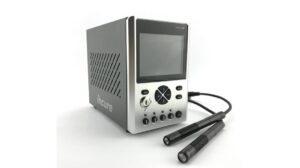
Spot Radiometers
Standard UV radiometers used for conveyor systems are often too large or incorrectly calibrated for the focused, high-intensity beams produced by spot curing systems. A dedicated “Spot Radiometer” usually features a specialized aperture or an adapter specifically designed to accept the tip of a light guide (typically 3mm, 5mm, or 8mm in diameter).
Wavelength Sensitivity
UV curing is not a “one size fits all” spectrum. Engineers must match the radiometer’s sensor to the wavelength of the light source.
- Broadband Mercury Lamps: These emit a wide range of UV-A, UV-B, and UV-C light. A radiometer for these systems must be calibrated to a broad range (often 250nm to 450nm).
- UV LED Systems: These are monochromatic, usually peaking at 365nm, 385nm, 395nm, or 405nm. Using a broadband radiometer to measure a 365nm LED will result in highly inaccurate readings. Engineers use LED-specific sensors that are calibrated precisely to the narrow peak of the LED source.
Step-by-Step: How Engineers Conduct the Measurement
Measuring UV intensity in a laboratory or on a production line requires a standardized approach to ensure repeatability. If the measurement technique varies, the data is useless.
1. Cleaning and Inspection
Before taking a measurement, the engineer inspects the light guide tip and the radiometer sensor window. Even a fingerprint or a tiny speck of cured adhesive on the light guide can block a significant percentage of the UV light, leading to a false low reading.
2. Setting the Measurement Geometry
Distance is the enemy of UV intensity. Because of the “Inverse Square Law,” the intensity of light drops off rapidly as the distance from the source increases. Engineers use jigs or fixtures to ensure the light guide is held at the exact same distance and angle from the sensor every time. In many spot curing systems, the light guide is inserted directly into a port on the radiometer, which eliminates distance variables by providing a fixed “zero-distance” measurement.
3. Accounting for Warm-up Time
Mercury-based spot curing systems require a warm-up period (usually 2 to 5 minutes) to reach a stable plasma state and full intensity. Engineers wait for the system to stabilize before recording data. UV LED systems are “instant on,” but they can still experience a slight drop in intensity during the first few seconds of operation due to thermal effects. A common practice is to trigger the light for 1-2 seconds before taking the official reading.
4. Data Logging and Averaging
Modern radiometers allow engineers to capture peak intensity and total energy. Many engineers will take three consecutive readings and calculate the average to account for any minor fluctuations in the power supply or the light source’s internal cooling cycles.
Advanced Considerations in UV Measurement
For high-precision engineering, simply looking at a number on a screen isn’t enough. Several technical factors can influence the accuracy of UV intensity measurements.
The Impact of Heat
High-intensity UV sources generate significant heat. UV sensors are electronic components, and their sensitivity can shift if they become too hot. This is known as the “temperature coefficient” of the sensor. Professional-grade radiometers are designed to withstand short bursts of high heat, but engineers must be careful not to leave the sensor exposed to a high-power spot lamp for extended periods, as this can damage the sensor or cause “thermal drift” in the readings.
Solarization of Optics
The internal filters and sensors within a radiometer are themselves subject to UV damage over time. This process, called solarization, gradually reduces the sensor’s sensitivity. This is why annual calibration is not just a recommendation—it is a requirement for maintaining accuracy. Engineers look for “NIST-traceable” calibration to ensure their measurements align with international standards.
Beam Profile and Uniformity
In spot curing, the beam is not always perfectly uniform. There may be “hot spots” in the center or “drop-offs” at the edges. While a spot radiometer measures the average intensity across its aperture, engineers sometimes use beam profiling cameras or fluorescent plates to visualize the beam shape. This is particularly important when curing larger areas using multiple spot guides in an array.
Maintaining the Spot Curing System Based on Data
Once the measurements are taken, the engineer must act on the data. This is where process control comes into play.
Setting Control Limits
Engineers typically establish “Upper Control Limits” (UCL) and “Lower Control Limits” (LCL). For example, if the validated process requires 5,000 mW/cm², the engineer might set the LCL at 4,500 mW/cm². If a daily check shows the intensity has dropped below this threshold, the system is flagged for maintenance—perhaps a light guide replacement or a lamp change—before any defective products are manufactured.
Adjusting Power Output
Many modern UV LED spot curing systems allow for digital power adjustment. If the measurement shows the intensity has dropped by 5% due to aging, the engineer can increase the current to the LED to bring the intensity back to the target level. However, this is a temporary fix; eventually, the LED will reach its thermal limit and must be replaced.
The Future of UV Intensity Measurement
As Industry 4.0 integrates into manufacturing, the way engineers measure UV intensity is evolving. We are moving away from manual, periodic checks toward continuous, real-time monitoring.
In-Line Sensors
Some advanced spot curing systems now feature internal sensors that monitor the UV output at the source. While this doesn’t account for losses in the light guide, it provides a “heartbeat” for the system. More advanced setups use “beam splitters” or secondary sensors at the point of cure to provide real-time feedback to the PLC (Programmable Logic Controller), allowing the system to automatically adjust exposure time to compensate for intensity fluctuations.
Wireless Data Integration
Modern radiometers are now equipped with Bluetooth or Wi-Fi connectivity. This allows engineers to instantly upload measurement data to a centralized database. This digital paper trail is invaluable for quality audits and for analyzing long-term degradation trends across multiple production lines.
Conclusion: The Path to Process Excellence
Measuring UV intensity in spot curing systems is a blend of science and disciplined practice. For the engineer, the goal is to eliminate variables. By using the correct radiometer, maintaining a fixed measurement geometry, and understanding the spectral characteristics of the light source, manufacturers can ensure that every bond is as strong as the first.
In an era where components are getting smaller and performance requirements are getting stricter, the “set it and forget it” approach to UV curing is no longer viable. Precision measurement is the only way to guarantee that the invisible energy of UV light is working exactly as intended. By mastering these measurement techniques, engineers protect their products, their reputations, and their company’s bottom line.
The reliability of a UV spot curing process is only as good as the data supporting it. Through regular calibration, rigorous measurement protocols, and a deep understanding of the equipment, engineers can turn a complex photochemical process into a predictable, high-performance manufacturing asset.
Visit www.blazeasia.com for more information.